


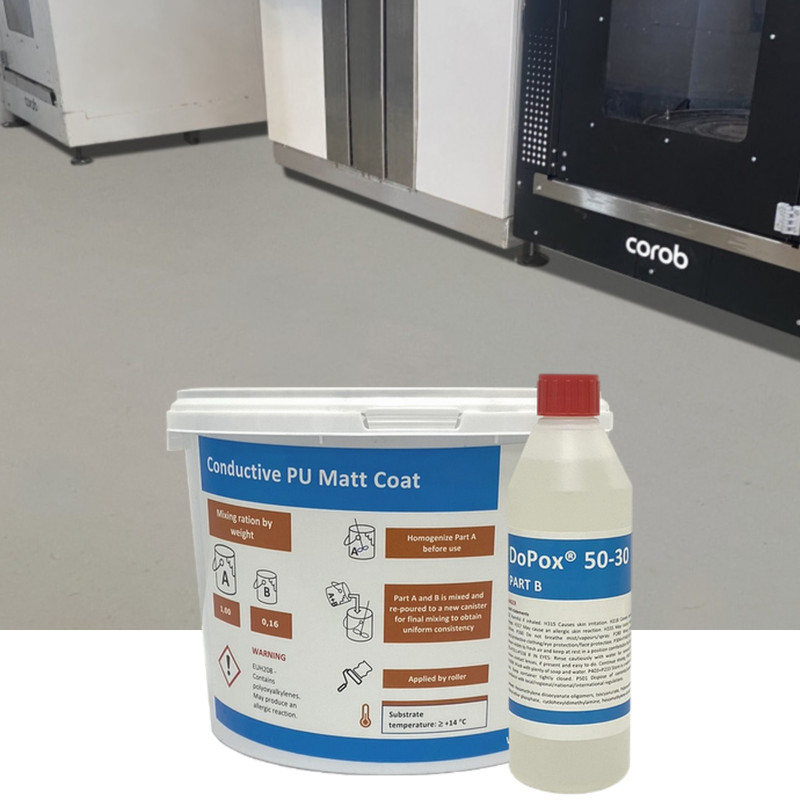
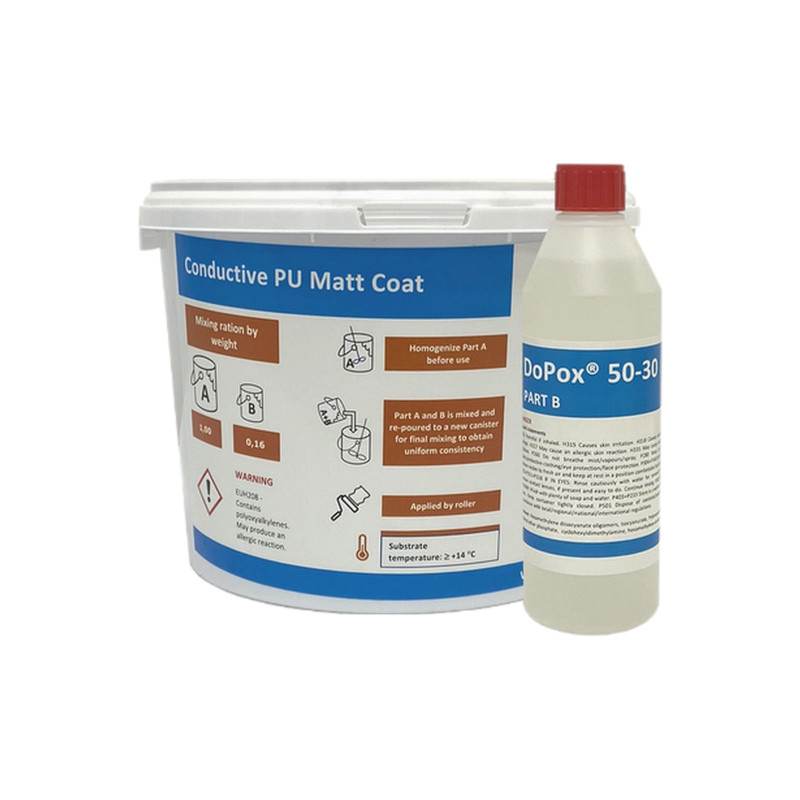


Antistatic renovation paint - DoPox® ConductiveCoat 50-30
DoPox® ConductiveCoat 50-30 anti-static renovation paint is a two-component, water-based aliphatic polyurethane designed for the renovation of existing, functioning anti-static systems.
The paint has very good conductive properties - 0.09 - 0.15 x 10⁶ Ω (95 - 150 kΩ). It has been tested in accordance with IEC 61340 for use in antistatic and ESD floors.
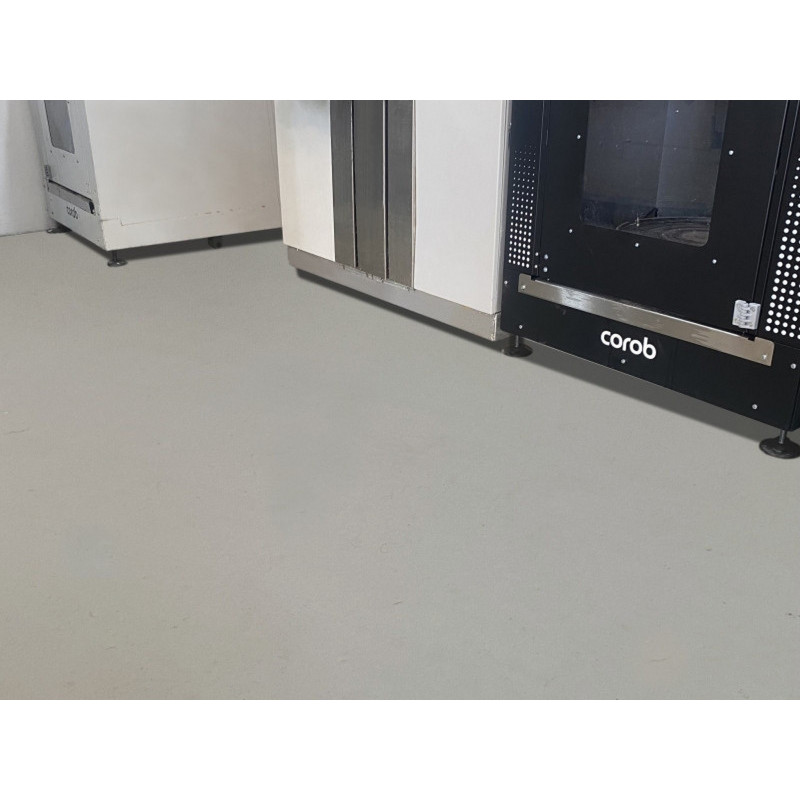
The paint creates an aesthetic, uniform, matte finish on the substrate with good washability (note: glossy floors have better washability).
ConductiveCoat 50-30 antistatic paint is ideal for renovating antistatic systems in, among others, the electronics and printing industries, the automotive industry, paint shops, the chemical industry, etc.
Note!
ConductiveCoat 50-30 paint is intended exclusively for the renovation of existing, functioning antistatic systems. When creating new antistatic floors, use the following products: Rompox 1102 AE or Rompox 1107 ESD.
Consumption: 0.06 - 0.18 kg/m² per coat
More information about ConductiveCoat 50-30 antistatic renovation paint.
Key features:
Product characteristics
- very good conductive properties,
0.09 - 0.15 x 10⁶ Ω (95 - 150 kΩ), - tested in accordance with IEC 61340 for use in antistatic
and ESD floors,
Resistance
- high abrasion and scratch resistance (
mechanical and chemical resistance depends on the antistatic system used), - increased resistance to household chemicals,
Aesthetics
- uniform, matte finish,
- excellent spreadability and leveling,
prevents roller marks during application, - washability,
matte floor with good washability (note: glossy floors have better washability),
Application
- for floor renovation in the electronics and printing industries,
- for floor renovation in the automotive industry, in paint shops,
- for floor renovation in the chemical industry, etc.
Systems:
| System type: | System per m2: | Coating thickness: |
|---|---|---|
| Full antistatic ESD system - applied with a notched squeegee/roller - for very heavy loads - approx. 2 mm thick |
1-2 x 0.25 kg of HeavyBond 30-33 primer + 0.25 lm of NX1106 copper tape + 1-2 x 0.15 kg of Static Guard 30-11 AS conductive resin + 2 kg of Static Guard 30-52 AS antistatic flooring + 2 x 0.1 kg of ConductiveCoat 50-30 antistatic paint |
approx. 2 mm |
| System for renovating antistatic ESD floors - for old, cleaned and roughened antistatic floors - applied with a roller - approx. 0.2 mm thick |
2 x 0.1 kg of ConductiveCoat 50-30 antistatic paint | approx. 0.2 mm |
The systems presented are general recommendations. Each project should be treated individually. In case of any doubts, please contact us so that we can select the appropriate system for the specific problem.
Documentation:

Datasheets
- Technical Datasheet - detailed product properties and application method
- Safety Data Sheet - base - chemical, health and safety, and transport information
- Safety Data Sheet - hardener - chemical, health and safety, and transport information
Real case: restoration of the effectiveness of an antistatic floor without dismantling the 100 MΩ system -
from 100 MΩ (10⁸ Ω) -> below 1 MΩ (<10⁶ Ω) in 1 day
In one industrial facility, the user operated an antistatic floor installed over 10 years ago. Initially, the system fulfilled its purpose, but over the years its effectiveness decreased significantly.
Initial condition
Measurements showed that the resistance of the floor had increased to approx. 100 MΩ (10⁸ Ω), which meant that electrostatic charges were dissipated very slowly. Despite the presence of the old antistatic layer, the floor had in practice ceased to perform its protective function.
This type of phenomenon is typical for older systems:
- the working layer wears out,
- conductive additives lose their continuity,
- the coating remains visually intact but electrically inactive.
The solution applied
Instead of costly removal of the entire floor, the top layer was sanded and then a single layer of ConductiveCoat 50-30 was applied as an active element of the antistatic system.
This treatment:
- removed the degraded layer with high resistance,
- ensured good mechanical and electrical adhesion,
- created a new, continuous conductive network.
Final result
After application, measurements were taken again. The surface resistance obtained fell below 1 MΩ (<10⁶ Ω), which means:
- immediate dissipation of electrostatic charges,
- real, not just declarative, antistatic functionality,
- restoration of full usability of the floor without interfering with the substrate structure.
Importantly, this effect was achieved thanks to the continuity of the conductive layer, not its thickness. A thin, homogeneous conductive coating works more effectively than a thick but degraded layer of the old system.
Conclusions from the implementation
This case shows that:
- the effectiveness of antistatic properties depends on the quality and continuity of the conductive layer,
- old antistatic floors can be effectively modernized,
- the use of a conductive coating avoids costly demolition and production downtime.
The solution was assessed by the user as fully satisfactory in both technical and economic terms.


